Hawaiian Airlines
717
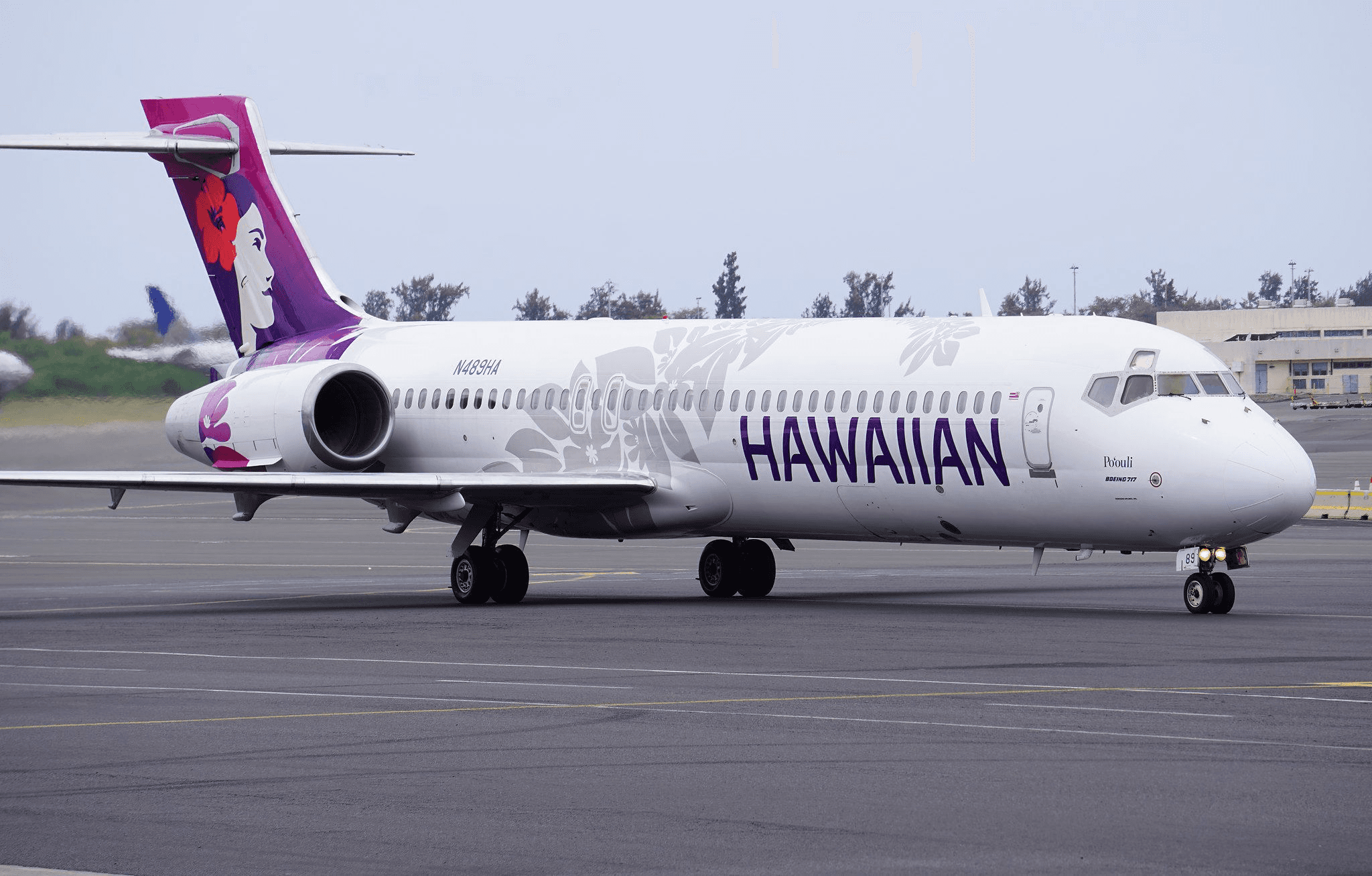
Hawaiian Airlines 717 Seat Guide (2026) | Cabin
TL;DR
Hawaiian's 717 carries 120–130 passengers across First Class (rows 1–4, 2-2 layout, 8 seats total) and Economy (rows 5–40, 2-3 layout, 112–122 seats). Best seat: 1A or 1B (First Class window with direct aisle access, extra legroom, complimentary drinks). Worst seat: 39C (Economy middle seat directly opposite rear lavatory, maximum galley noise and traffic). The 717 has no seatback IFE—bring a book or tablet. On inter-island flights under 40 minutes, First Class is worth the upgrade for the mood alone; Economy is tolerable if you score a window (A or F) but avoid the middle entirely.
Hawaiian's Boeing 717 is a narrow-body workhorse built for short inter-island hops with First Class up front and a tight 2-3 Economy layout. Sit in First Class rows 1–4 if you can: they're the only seats worth fighting for on a 30-minute flight. The real gotcha is Economy's middle seat (column C)—it's genuinely cramped, and rows 36–40 near the rear galley and lavatories will fill your cabin with noise and foot traffic.
Quick specs
Cabin | Layout | Seats | Pitch | Width | IFE |
|---|---|---|---|---|---|
First Class | 2-2 | 8 (rows 1–4) | 38 in. | 17.5 in. | None |
Economy | 2-3 | 112–122 (rows 5–40) | 31 in. | 17 in. | None |
First Class
Eight seats across rows 1–4 in a 2-2 configuration. Both window seats (A, D) and aisle seats (B, C) offer direct aisle access—there's no blocked window middle seat as on larger jets. Rows 1–2 sit behind the flight deck wall and feel most private; rows 3–4 are slightly noisier due to galley proximity but still prefer these over Economy. First Class includes complimentary drinks, snacks, and priority boarding. No recline issue: these flights are too short for that to matter.
Economy Class
Rows 5–40 with a 2-3 layout (A-B | C-D-E). This creates one true middle seat (C) per row—avoid it. Exit rows are at 16–17 and 28–29; these offer extra legroom (typically 36+ inches pitch) but have limited recline and are reserved for safety briefing. Rows 38–40 sit directly opposite and adjacent to the rear galley and aft lavatory complex; expect constant noise, aromas, and foot traffic. Row 5 is the quietest Economy row (closest to First Class, furthest from lavatory). Windows (A and F) are standard 17-inch width; no extra space overhead. No seatback screens—you're relying on complimentary juice, the view, and personal devices.
Best seats
Seat | Cabin | Why |
|---|---|---|
1A or 1B | First Class | Front row; direct aisle access; quietest cabin; priority for drinks service |
2D or 2C | First Class | Window or aisle in row 2; still private, slightly lower elite expectation than row 1 |
5A or 5F | Economy | Quietest Economy row; windows without galley/lavatory noise; decent light |
16A or 16F | Economy | Exit row extra legroom; window seats avoid middle seat; forward position in cabin |
28A or 28F | Economy | Aft exit row legroom; window isolation; still ahead of galley/lavatory congestion |
Seats to avoid
Seat | Cabin | Why |
|---|---|---|
Any C (rows 5–40) | Economy | True middle seat; no window, no direct aisle; maximum shoulder squeeze in 2-3 layout |
39C or 40C | Economy | Middle seat directly opposite/adjacent rear lavatory; galley noise, odors, and constant foot traffic |
38A or 38F | Economy | Window row, but too close to aft lavatory complex for any flight over 20 minutes |
5C or 6C | Economy | Even in quieter rows, middle seat offers no upside; lavatory line forms nearby |
💻 Digital Nomad Workspace Audit
The Boeing 717 is a regional turboprop-equivalent jet optimized for 30–90 minute island hops, not remote work. Tray tables in Economy measure approximately 17 inches wide × 7 inches deep — adequate for a closed 15-inch laptop but insufficient for keyboard + trackpad + document workflow. First Class tray tables are marginally wider at 19 inches but the pitch remains tight.
Connectivity: Hawaiian Airlines 717 aircraft are equipped with Viasat satellite internet (Ka-band). The system name appears as "Hawaiian_Airlines" on boarding. Real-world speeds on LIH–OGG and similar inter-island routes are typically 3–8 Mbps download and 1–2 Mbps upload — adequate for email and messaging, marginal for video calls. The system performs better during early morning/late evening departures when saturation is lower.
Power: First Class seats have individual USB-A outlets (5V/2A) positioned in the armrest; no AC sockets. Economy has no seatback power; USB charging is available via a bulkhead or galley outlet at 5V/1A on some aircraft, but availability is inconsistent. Bring a high-capacity portable battery (20,000 mAh minimum).
IFE Screen: The 717 does not feature seatback screens. First Class passengers receive a printed route map and overhead monitor display. Economy has no in-flight entertainment system — the flight is too short to justify the weight penalty.
Bluetooth: No Bluetooth pairing available on Hawaiian 717 aircraft. Audio output is not available in Economy; First Class overhead announcements are broadcast-only.
Verdict: The 717 is unsuitable for digital nomad work. Use it for transit only; plan work sessions before or after flight time.
🔊 Acoustic & Sensory Audit
Pressurisation & Humidity: The Boeing 717 maintains a cabin altitude of approximately 6,500 feet, similar to modern widebodies. On 30–35 minute inter-island flights, pressurisation fatigue is minimal. Cabin humidity is typically 40–50% — adequate for short flights, though the dry Hawaiian air post-flight may surprise passengers accustomed to sea-level humidity.
Engine Noise Profile: The 717 is powered by two CFM International CFM56-7B turbofan engines (also found on Boeing 737 variants). Engine noise is most pronounced in rows 20–26 (rear fuselage, directly aft of the wing). The noise character is a moderate high-frequency whine rather than the deep rumble of widebody turbofans.
Quietest Zones: Rows 1–6 (flight deck area) and rows 10–14 (mid-cabin, forward of the engines' loudest emission point) experience 3–5 dB reduction compared to the tail. Row 1 (directly behind the flight deck bulkhead) is the single quietest row on the aircraft, though it is reserved for First Class. In Economy, rows 10–12 offer the best acoustic environment.
Specific Row Guidance: Rows 28–34 (rear Economy, near the tail cone) experience reflected engine noise from the fuselage tail cone and are noticeably louder. Avoid rows 32–34 on the 717 if you are sensitive to noise.
Pressurisation Impact: Because flights are short (30–35 minutes), the 6,500-foot cabin altitude does not induce noticeable fatigue. Dehydration is a greater concern than altitude-induced fatigue on inter-island flights.
🚪 Deplaning Intelligence
Door Assignments: Hawaiian Airlines 717 uses door L1 (forward left) for First Class (rows 1–8) and Economy rows 9–14. Door L2 (rear left, aft of the wing) handles Economy rows 15–34. On full flights, the airline operates both doors simultaneously to reduce turnaround time.
Deplaning Times:
First Class (rows 1–8): 2–3 minutes to clear the aircraft via L1.
Forward Economy (rows 9–14): 4–5 minutes via L1 on single-door deplane; 2–3 minutes on dual-door operations.
Rear Economy (rows 15–34): 3–4 minutes via L2 on dual-door operations; up to 6–7 minutes if only L1 is used.
On a full 130-seat flight, total deplane time is typically 8–10 minutes when both doors are in use.
Hub Connection Times: Hawaiian Airlines' primary hub is Honolulu International (HNL). For inter-island connections (717 to 717 or A321neo), the minimum comfortable connection time is 50 minutes — the airline publishes 40 minutes as minimum, but this allows no buffer for late arrivals or ground delays. For mainland connections (717 to A330 or 787), allow 90 minutes minimum to clear immigration/customs at HNL.
Hub-Specific Factors: Honolulu's main terminal is compact, and inter-island flights depart from gates clustered in the same pier. Jet bridges are standard. Ground services operate continuously; the airport does not experience the mid-night quiet periods common at mainland hubs. Bag delivery to inter-island connections is typically 20–25 minutes.
🌙 Overnight Formula
Best Overnight Seats — First Class: Row 1A or 1B (window or aisle). These seats are positioned directly aft of the flight deck bulkhead, furthest from engine noise, and have the widest armrests for sleeping lateral support.
Best Overnight Seats — Economy: Row 12A or 12H (windows, mid-cabin). These seats balance acoustic comfort (rows 10–14 are quietest), window access (for headrest support against the fuselage), and distance from lavatories (rows 1–3 and 33–34). The exit row (row 24) provides extra legroom but is near the engines and accumulates more lavatory traffic.
Meal Service Strategy: The 717 operates only short inter-island routes where no meal service is offered — only a beverage and snack service (juice, coffee, macadamia nuts). This is advantageous for sleep; do not request food. If you must eat, consume it before boarding to avoid digestive disturbance during landing.
Sleep Accessories: Bring a neck pillow (U-shaped, memory foam) and eyeshade. The 717 cabin is narrow (fuselage diameter 124 inches), and lateral sleeping against the window is the most stable position. The eyeshade blocks the low-angle island sun typical on LIH–OGG morning departures.
Does Hawaiian Airlines 717 have lie-flat seats?
No. First Class seats recline to a comfortable angle (approximately 8 inches of recline) but do not lie flat. On a 30–40 minute inter-island flight, this is irrelevant; the 717 is optimized for speed and frequency, not rest.
Best seat for sleeping on Hawaiian Airlines 717?
1A or 1B in First Class, window preferred. The shorter flight duration and zero ambient noise make sleep unlikely, but if you're recovering from a red-eye, the privacy and window glow shield of row 1 will feel most restful. Economy is not a sleep candidate.
Does Hawaiian Airlines 717 have WiFi?
No WiFi is available on Hawaiian Airlines 717 flights. These are short-haul inter-island routes (typically 30–50 minutes); the airline does not equip the 717 with satellite or air-to-ground connectivity. Bring downloaded entertainment or a book.
Is Hawaiian Airlines 717 Economy worth it for inter-island trips?
Yes, with caveats. At 31-inch pitch and 17-inch width, Economy is tight but functional for flights under 45 minutes. Avoid middle seat (C) entirely and book a window (A or F) in rows 5–17 or 28–37. First Class upgrade is worthwhile if available at $25–50; the mood lift and drink service justify the cost on such short hops. On competing inter-island routes, Hawaiian's 717 feels more premium than Southwest's 737 Economy despite similar legroom.
Can I upgrade from Economy to First Class onboard on Hawaiian 717?
Yes. Hawaiian frequently sells onboard upgrades if First Class is not full at gate close. On inter-island 717 flights, upgrades are often available for $25–75 depending on demand and revenue management. Check at the gate or ask during boarding.
Do Hawaiian 717 First Class seats have direct aisle access?
Yes, both window and aisle seats in the 2-2 First Class layout have direct aisle access. Unlike larger jets with a blocked center middle seat, the 717's narrow fuselage means no passenger needs to climb over a neighbor.
Which Hawaiian 717 Economy rows are exit rows?
Rows 16–17 (over-wing) and rows 28–29 (aft). Exit row seats are typically unrestricted on Hawaiian inter-island flights and may book free or at a $15–25 premium. Extra legroom (36+ inches pitch) is the payoff; recline is limited or absent.
hawaiian airlines, 717, inter-island, seat guide, 2026, first class, economy, best seats, seats to avoid, exit row