Emirates
Airbus A380-800
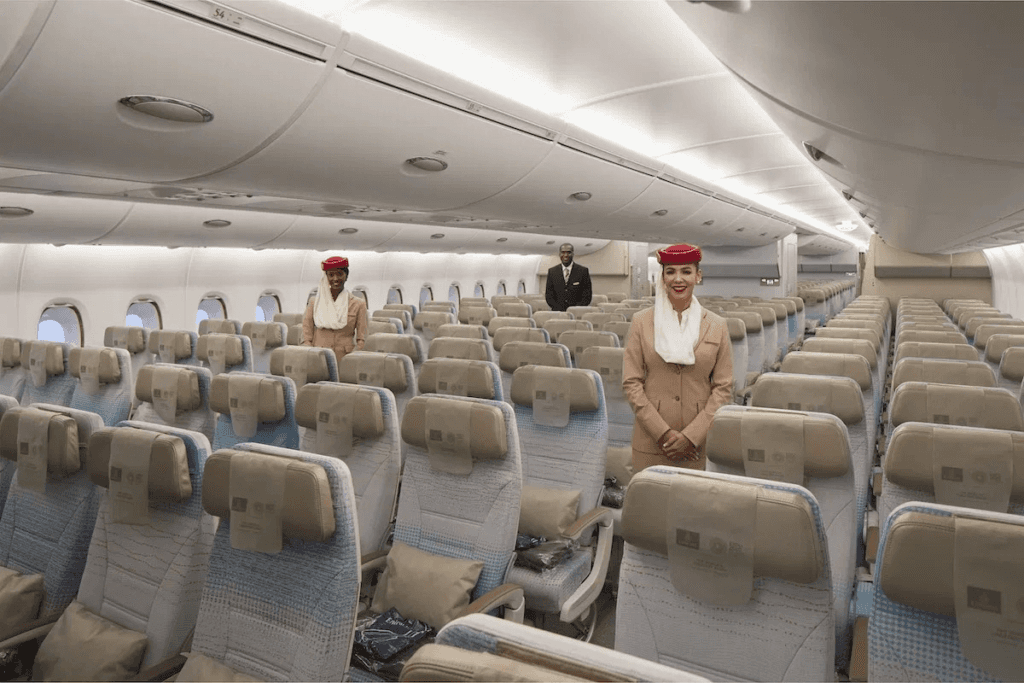
Emirates A380-800 Economy Class Seat Guide (2026) | Cabin
TL;DR
Emirates A380-800 Economy has three distinct sections: a small forward main deck cabin, a large rear main deck cabin, and a small upper deck Economy section. The forward main deck (rows 41-50 approximately) is the standout position - smallest cabin, first served, first to deplane, closest to the acoustic sweet spot ahead of the wing engines. The upper deck Economy section is the quietest but smallest and books quickly. The large rear main deck cabin is what most passengers get. Exit row selection within any section is the primary legroom lever. Avoid the last rows of the rear main deck at all costs on overnight routes.
Try Cabin
Emirates Economy on the A380-800 is one of the most-searched seat intelligence topics in long-haul aviation - and one of the most misunderstood. The aircraft has two Economy sections on the main deck separated by a galley, plus a small Economy section on the upper deck. Knowing which section you're in, and which rows to target, changes the quality of a 14-hour crossing significantly.
Emirates operates the Airbus A380-800 on its highest-frequency routes from Dubai International - London Heathrow, Sydney, New York JFK, Los Angeles, Singapore, Bangkok, and dozens of other destinations. The aircraft carries approximately 489 passengers in the standard three-class configuration, with Economy occupying the majority of the main deck and a small section of the upper deck. For Economy passengers, understanding the cabin geography of the A380 is the difference between a manageable 14-hour crossing and an unnecessarily difficult one.
The three Economy sections explained
Emirates A380-800 Economy is not a single undifferentiated block. The main deck is divided into a forward Economy section and a rear Economy section by a galley break, and there is a separate small Economy section on the upper deck. Each section has a distinct experience profile:
The forward main deck Economy section (rows 41-50 approximately) sits immediately behind the Business Class cabin. It is the smallest Economy section - typically 50-60 seats - and is served by its own forward galley. Crew attention here is proportionally better than in the 300-seat rear main deck. Meal service begins earlier in this section. Deplaning is through Door L2, which this section exits closest to. And critically, this section sits ahead of the wing engines — the forward part of the A380's main deck is measurably quieter than the rear.
The rear main deck Economy section (rows 51-87 approximately) is the largest cabin on the aircraft — over 300 seats in a 3-4-3 layout. This is where most Economy passengers end up. The acoustic profile worsens toward the rear as you move closer to the engine mounting points. The galley activity from the centre galley affects the rows immediately adjacent to the galley break. The last rows (84-87 typically) are the worst positions on the aircraft: no recline, rear galley noise, lavatories directly adjacent, and fuselage taper that reduces shoulder room.
The upper deck Economy section (rows 26-32 approximately, behind Business and First on the upper deck) is a small section in a 2-4-2 layout rather than the main deck's 3-4-3. With one middle seat maximum per window block, noticeably better acoustics due to the upper deck's position above the wing engines, and a smaller cabin with better service ratios, this is the best Economy section on the aircraft. These rows book quickly - select them at ticketing.
The 3-4-3 layout - navigating it correctly
The main deck Economy cabin uses a 3-4-3 layout at 10-abreast. Seat width is approximately 17.8 inches. The centre four-seat block (seats D, E, G, H or local equivalent) is the position that most disadvantages solo travelers - four passengers sharing two armrests with no natural personal space boundary on a 14-hour crossing. The outer 3-seat blocks on either side of the aircraft have a window seat, a middle seat, and an aisle seat. For solo travellers, the aisle seat in the outer 3-seat block is the least bad position in the rear main deck if window pairs and exit rows are unavailable - you have one neighbour rather than two, and aisle access without disturbing anyone.
Window pairs - the correct booking target
The A380's fuselage is wide enough that the 3-4-3 layout places the window seats at positions A/B on the left side and K/J on the right side. In the outer 3-seat blocks, the A seat is a window seat and the B seat is the middle of that block - but crucially, the C seat is the aisle of that block, not another middle seat. This means seats A and B in the outer block share a 2-seat window-side section between them. For couples specifically, booking the A and B pair (or the J and K pair on the right) gives you a 2-seat window section with only each other as neighbors and the fuselage wall providing natural physical boundary. This is one of the better couples Economy configurations on any 10-abreast widebody.
Exit rows
Exit rows on the Emirates A380-800 main deck provide the best legroom available in main deck Economy. There are typically three exit row positions on the main deck: one at the forward/rear main deck galley break, and two more toward the rear of the aircraft. The forward exit row (at the galley break between the two main deck sections, around rows 50-51) is the most sought-after - it offers extra legroom and sits at the acoustic transition point between the quieter forward section and the noisier rear section. Seats in the outer 3-seat blocks at this exit row provide extra legroom and only one neighbor. Exit row seats have armrest tray tables and no under-seat storage during takeoff and landing.
Premium Economy - a note for context
Emirates added a Premium Economy cabin to the A380-800 on select routes in 2022. This section (rows 33-38 approximately on the main deck) is a 2-4-2 layout with 38 inches of pitch and a dedicated service. On routes where Premium Economy is available, it is the correct upgrade target from standard Economy - the 2-4-2 layout gives window pairs their own 2-seat section with no middle neighbor, and 38 inches of pitch is meaningful on a 14-hour crossing. Not all A380 routes carry Premium Economy; check the seat map when booking.
The ice system and IFE
Emirates' ICE (Information, Communications, Entertainment) system is the best IFE in Economy globally by most passenger assessments - a 13.3-inch touchscreen with the largest content library in commercial aviation at approximately 6,500 channels. This is not incidental: on a 14-hour flight, a genuinely good IFE system with a large library meaningfully affects the experience. USB-A charging is standard at every Economy seat. AC outlets are available at exit rows and some other positions - not universal in standard Economy.
Dubai connection intelligence
Dubai International Terminal 3 handles all Emirates departures and is one of the most efficiently designed airport terminals for the passenger volumes it processes. The Emirates Lounge in Terminal 3 is available for Business and First Class passengers. For Economy passengers transiting through DXB, the connection experience is generally smooth - the terminal is modern, signage is clear, and security re-screening between international connections is not required for most routings. A 90-minute connection at DXB is comfortable. The terminal's retail and food options are extensive if you have a longer layover.
Acoustic profile by section
The A380's four GP7200 engines mounted far out on the wide delta wings create a noise profile where the fuselage centre (Economy) receives less engine noise than on narrower-wing twin-engine aircraft. Within the cabin, the gradient runs forward-to-back: the forward main deck section is the quietest Economy zone, the rear main deck worsens progressively toward the tail, and the upper deck is quietest of all due to its elevation above the engine line. Passengers who have flown both the A380 and 777-300ER in Economy on the same DXB-LHR route consistently report the A380 as noticeably quieter, particularly in the forward cabin.
Best seats
Seat | Section | Why |
|---|---|---|
Upper deck window pair (rows 26-32 A/B or J/K) | Upper deck Economy | 2-4-2 layout, one neighbor maximum, quietest Economy section on the aircraft. Book at ticketing - fills first. |
Forward main deck A or K (rows 41-50) | Forward main deck | Smallest section, earliest service, first to deplane, acoustic sweet spot ahead of engine zone. |
Galley-break exit row A or K (rows 50-51) | Main deck exit | Best main deck legroom. Acoustic transition point - still forward of the worst engine noise. |
Forward main deck A and B pair (or J and K) | Forward main deck | Couples configuration. Window pair with only each other as neighbours and fuselage wall boundary. |
Seats to avoid
Seat | Why |
|---|---|
Last 4 rows of rear main deck (rows 84-87) | No recline, rear galley noise directly adjacent, lavatories on both sides, fuselage taper reduces shoulder room. The worst position on the aircraft on any overnight route. |
Rear main deck centre block D-H (any row) | Four passengers sharing two armrests on a 14-hour crossing. Avoid if outer block or exit row seats are available. |
Rows immediately adjacent to centre galley break | Galley activity during the meal service window affects these rows - light bleed and crew movement throughout the first 3 hours of flight and again during the pre-landing service. |
Is Emirates A380 Economy on the upper deck better than the main deck?
Yes - meaningfully. The upper deck Economy uses a 2-4-2 layout (one middle seat per window block maximum) rather than the main deck's 3-4-3, and the upper deck is noticeably quieter. Upper deck Economy rows are limited and book quickly; select them at the time of ticketing if available at the same fare.
What is the seat pitch in Emirates A380 Economy?
32 inches on both the main deck and upper deck Economy sections - the same across all Economy positions. The layout difference (2-4-2 upper deck versus 3-4-3 main deck) is the primary differentiator between sections, not pitch.
Does Emirates A380 Economy have AC outlets?
AC outlets are available at exit row seats and some other positions but are not universal in standard Economy rows. USB-A charging is standard at every Economy seat. If AC access is critical, book an exit row.
How does Emirates A380 Economy compare to 777-300ER Economy?
On the same DXB routes, the A380 forward main deck Economy is quieter and served by a smaller dedicated cabin with better crew ratios. The 777-300ER Economy on Emirates is 10-abreast 3-4-3 on both aircraft, but the A380's four-engine acoustic profile and the forward mini-cabin advantage make the A380 the preferable aircraft in Economy when the choice exists.
What rows are the exit rows on Emirates A380-800 Economy?
Exit row positions vary by specific aircraft configuration. On most Emirates A380-800s, there are exit rows at approximately rows 50-51 (the galley break between the two main deck sections) and at one or two additional points in the rear main deck. Check the specific seat map for your flight to identify the exact exit row positions - they are shown with the standard exit row indicators in the Emirates booking interface.
emirates, a380, economy, upper deck, main deck, seat guide, dubai, long haul