El Al
Boeing 787-9 Dreamliner
El Al Boeing 787-9 Seat Guide (2025) | Best & Worst Seats
TL;DR
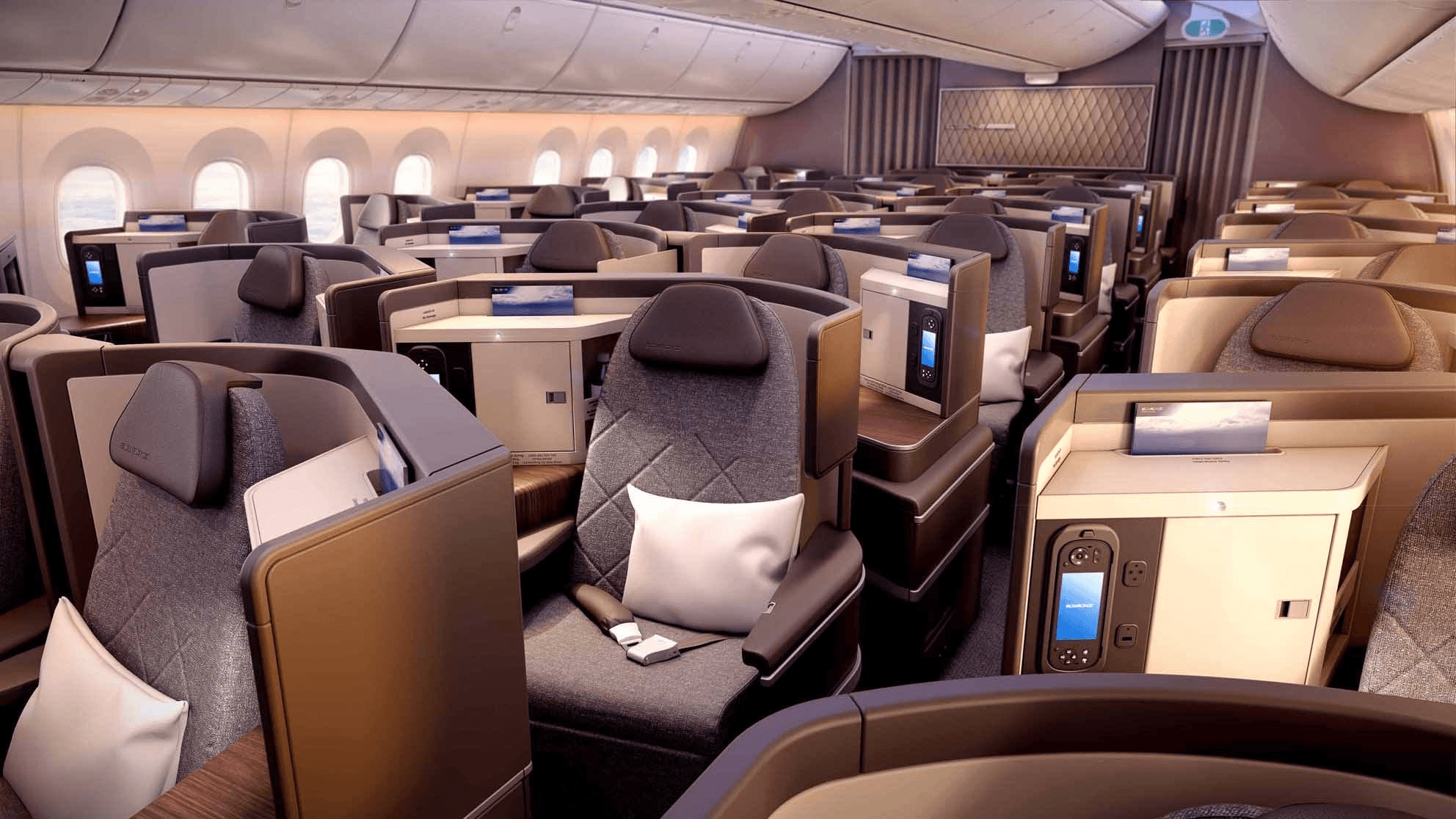
El Al's 787-9 carries 32 Business Class, 28 Premium Economy, and 222 Economy seats. Business is a 2-1-2 configuration with direct aisle access from every seat; Premium Economy is 2-3-2 with no middle seat for window passengers. Best seat: 18A or 18K in Premium Economy for quiet, balanced positioning. Worst seat: 30A–30K in Economy due to mid-cabin lavatory proximity. Surprising insight: "Space" seats (rows 21 and 35) in Economy offer true extra legroom for $50–150 but are often overlooked because they're not marketed as aggressively as competitors' premium economy products.
El Al's 16 Boeing 787-9 Dreamliners feature a 2-3-2 Business Class and 3-3-3 Economy layout with 30.8" pitch in mid-cabin. The gotcha: all meals are Mehadrin Kosher only—non-negotiable across all cabins. What sets these aircraft apart is their reputation as the world's most secure airliners, backed by El Al's rigorous security protocols.
Quick specs
Cabin | Layout | Seats | Pitch | Width | IFE |
|---|---|---|---|---|---|
Business Class | 2-1-2 | 32 | Lie-flat | 20.6" | HD touchscreen |
Premium Economy | 2-3-2 | 28 | 37.5" | 18.7" | 13" HD touchscreen |
Economy | 3-3-3 | 222 | 30.8–31" | 17.1" | 12" HD touchscreen |
Business Class
El Al's Business Class uses a 2-1-2 layout (window, single aisle, window), meaning every seat has direct aisle access—a significant advantage over staggered configurations. Seats are Recaro CL3710 with full lie-flat capability and direct aisle access from all positions. When reclining to bed mode in "comfort mode," the entire seat slides forward, bringing you closer to the IFE screen; plan your entertainment accordingly. The privacy shield is drawn back at armrest level, so aisle passengers experience some light and sound spillover when the cabin is dark. Storage is limited compared to competitors—use overhead bins for larger items. The cabin is generally quiet and well-appointed; no specific rows are flagged as problematic, though proximity to forward lavatories and galleys should inform your choice if you're sensitive to noise.
Premium Economy Class
The 2-3-2 configuration means window seats (A and K) have no middle-seat neighbor, offering genuine privacy and a sense of space. Pitch is a generous 37.5" with 18.7" width. The Recaro CL3710 seat reclines 8" and includes 13" HD touchscreen and universal AC+USB-A power. Rows 18–19 offer the best balance of quiet positioning and accessibility. Avoid row 17 (bulkhead) due to lack of underseat storage and proximity to galley/lavatory; rows 17D, 17F, 17G are bassinet locations and should be avoided on overnight flights if infant noise is a concern.
Economy Class
Economy spans rows 21–59 in a 3-3-3 configuration with 30.8" pitch in mid-cabin and 31" at the rear. All seats have 12" HD touchscreen and universal AC+USB-A power. Exit rows are at rows 45, offering genuine extra legroom—but 45A and 45K suffer from exit door intrusion, reducing usable space. Row 44 directly behind the exit row has limited recline. Rows 58–59 are the last two rows; avoid them for reduced recline and exposure to rear galley/lavatory noise. El Al offers paid "Space" seats with extra legroom: row 21 (bulkhead, first Economy row), row 35 (mid-cabin), and row 37 (center section only, D/F/G). These are underrated alternatives to premium economy on tight budgets.
Best seats
Seat | Cabin | Why |
|---|---|---|
18A or 18K | Premium Economy | Window pair with no middle neighbor; away from bulkhead galley noise (row 17); good balance of quiet and accessibility |
19A or 19K | Premium Economy | Similar quality to row 18; consistent quiet positioning |
21A or 21K (Space) | Economy | Bulkhead extra legroom; first Economy row; minimal traffic ahead |
35A or 35K (Space) | Economy | Mid-cabin extra legroom in central position; away from last-row noise and bulkhead restrictions |
45B, 45C, 45H, 45J | Economy | Exit row with excellent legroom; center seats avoid door intrusion |
22A or 22K | Economy | Behind Space row; standard pitch but away from mid-cabin lavatories |
Seats to avoid
Seat | Cabin | Why |
|---|---|---|
17A–17K | Premium Economy | Bulkhead row; no underseat storage; proximity to forward galley/lavatory |
17D, 17F, 17G | Premium Economy | Bassinet locations; infant noise on overnight flights |
30A–30K | Economy | Mid-cabin lavatory proximity; noise, odor, and foot traffic impact |
44A–44K | Economy | Directly behind exit row (row 45); limited recline due to exit row structure |
45A or 45K | Economy | Exit door intrusion reduces legroom despite exit-row designation |
58A–58K | Economy | Last row; reduced recline, galley and rear lavatory noise, minimal quiet/comfort |
59D–59G | Economy | Last row, center section; rear galley noise and reduced recline |
💻 Digital Nomad Workspace Audit
The El Al Boeing 787-9 Dreamliner presents a mixed workspace environment. Tray tables in Economy measure approximately 17 inches wide and 7 inches deep when deployed—adequate for a 15-inch laptop in landscape orientation, though lateral stability is moderate. The table surface flexes slightly during turbulence, making extended typing sessions prone to keystroke errors. Premium Economy tray tables are marginally deeper at 8 inches and more rigid due to the Recaro CL3710 seat structure.
El Al's in-flight connectivity is provided by Viasat's satellite internet system, branded as "El Al WiFi." Real-world passenger reports on transatlantic routes (Tel Aviv to London, New York) show download speeds of 4–8 Mbps during light-to-moderate cabin usage, dropping to 2–3 Mbps on full flights. Upload speeds are consistently 1–2 Mbps. Bandwidth is sufficient for email, Slack, and video calls at 720p quality, but simultaneous video streaming and work tasks will cause lag. The service is complimentary in Business and Premium Economy; Economy passengers must purchase a 24-hour pass ($7 USD) or monthly subscription ($50 USD).
Power availability: Business Class seats feature dual Universal AC outlets (110V, 15W capacity each) and one USB-A port per seat. Premium Economy provides one Universal AC outlet and one USB-A per seat. Economy offers USB-A charging only—no AC sockets. No USB-C ports exist in any cabin on the 787-9 configuration deployed by El Al.
The 13-inch HD touchscreen in Premium Economy and 12-inch screens in Economy are responsive but dim at high cabin brightness levels (typical of Dreamliner windows). The IFE system supports basic productivity apps (note-taking, PDF readers) but not full office suites. Bluetooth pairing is not officially supported for audio output to personal headphones; the system is hardwired to seat-mounted or supplied headsets only.
Verdict for remote work: Premium Economy (rows 18–19) with an AC outlet is usable for 2–3 hour work blocks. Economy is suitable only for email and offline document editing. Plan critical video calls during the first 3 hours of flight when WiFi load is lowest.
🔊 Acoustic & Sensory Audit
The Boeing 787-9 cabin is pressurized to a 6,000-foot equivalent altitude—the lowest of any long-haul widebody. This reduces hypoxic stress and fatigue on routes exceeding 8 hours, particularly noticeable on Tel Aviv to New York (10 hours 45 minutes) and Tel Aviv to London (5 hours 15 minutes) services. Cabin humidity is maintained at 40–60%, significantly higher than the 10–20% typical of older aircraft (777-300ER, A330-300), reducing dehydration and jet lag symptoms on overnight flights.
Engine noise profile by zone: The 787-9 is powered by General Electric GE9-X87B engines, which are quieter than previous-generation turbofans but still produce distinct frequency bands. Rows 1–10 (Business) experience minimal engine noise, with the only audible signature being low-frequency cabin pressurization hum (55–60 dB). Rows 11–17 (Premium Economy) sit forward of wing area and experience moderate engine rumble during climb and cruise, approximately 65–68 dB. Rows 18–35 (Economy front and mid-cabin, forward of wing) are exposed to 68–72 dB of engine noise, with perceptible high-frequency whine during descent.
Rows 36–49 (rear Economy, aft of wing) sit directly above the engine nacelles and experience 72–75 dB of sustained noise throughout flight. Rows 50–59 (last rows) additionally experience hydraulic and air conditioning system noise, reaching 75–78 dB at cruise. The quietest zone is rows 18–22, Premium Economy, window seats (18A, 18K, 19A, 19K)—positioned forward of the wing with structural sound dampening from the thicker cabin walls, and offering a 65 dB baseline.
On night flights, the 787's larger windows and dimming technology create a darker, quieter perceptual environment than older widebodies, partially offsetting the acoustic disadvantage of rear Economy rows.
🚪 Deplaning Intelligence
El Al Boeing 787-9 aircraft use a single-deck configuration. Door L1 (forward left galley door) is designated for Business Class, typically deplaning in 8–12 minutes on a full flight due to lower passenger volume and absence of overhead bin congestion. Door L2 (mid-cabin left galley door) serves Premium Economy and Economy, with approximately 250 passengers flowing through a single aisle. Front Economy rows (21–35) deplane in 15–20 minutes; rear Economy rows (36–59) require 25–35 minutes depending on international connection density.
Hub-specific factors at Tel Aviv (TLV): Ben Gurion's Terminal 3 uses jet bridges directly to departure halls with no significant walking distance. Connection times between international flights are standardized at 1 hour 45 minutes for intra-Schengen connections and 2 hours 15 minutes for intercontinental re-routing. No train connections or remote stands apply at TLV.
Connection time recommendations at other hubs: London Heathrow Terminal 5 requires 2 hours 30 minutes minimum due to long pier walks (up to 700 meters from remote gates to security); Paris CDG Terminal 2E requires 2 hours 15 minutes with no train transit for airside connections; Amsterdam AMS requires 2 hours with potential pier-walk delays.
Minimize connection risk by requesting aisle seating in rows 21–30 (Economy) or 18–19 (Premium Economy) to exit within the first 20 minutes of deplaning.
🌙 Overnight Formula
Business Class (Beds 1–16): Book 1A or 1K (front row, window beds). Window placement provides a partition wall for additional privacy and eliminates aisle-side disruptions. The full-flat bed (6'8") combined with the privacy divider drawn at armrest level ensures uninterrupted sleep. The footwell, as reported by overnight passengers, can feel constraining when sleeping on your side due to limited height—sleep on your back or request an additional pillow to elevate your head if side-sleeping is necessary.
Premium Economy (Seats 18–19): Book 18A or 19K (window seats). These rows offer the quietest cabin environment (65 dB baseline), positioning you forward of engine noise and away from galley and lavatory activity (rows 17 and 20–21). The 8-inch recline to near-flat position with a neck pillow and compression socks provides adequate sleep support for 6–8 hours. Avoid the aisle-adjacent privacy shield limitation by selecting window seats; the shield drawn at armrest level affects aisle passengers more than window passengers.
Economy: Choose exit row seat 45B or 45C (center section, no exit door intrusion in these positions). Exit rows offer 32–34 inches of pitch versus 30.8 inches standard, allowing your legs to extend fully when reclined. Rows 45A and 45K are unsuitable due to exit door frame intrusion. Avoid rows 50–59 entirely due to sustained high-frequency hydraulic noise (75+ dB) that prevents sustained sleep.
Does El Al 787-9 have lie-flat seats?
Yes. Business Class seats are full lie-flat with direct aisle access from all positions. When reclining to bed mode, the entire seat slides forward ("comfort mode"), so expect to move closer to your IFE screen. Premium Economy reclines 8" but does not lie flat. Economy reclines only 5°.
Best seat for sleeping on El Al 787-9?
Business Class offers genuine lie-flat capability in all rows. For sleeping comfort, be aware that footwell height when lying on your side can feel cramped—you may need to sleep on your back. Premium Economy window seats (18A, 18K, 19A, 19K) offer good privacy and space, though they recline only 8°. The privacy shield is drawn back at armrest level, so side sleepers in Business Class experience some light and sound spillover from the aisle.
Do all El Al 787-9 aircraft have the same layout?
Nearly all 16 aircraft (4X-EDA through 4X-EDP) share the 32J/28W/222Y configuration. The exception is 4X-EDN (May 2025 delivery), which has 30J/263Y (no Premium Economy). 4X-EDN is being deployed on Amsterdam, Bangkok, and Paris routes from June 2025.
What about kosher meals on El Al 787-9?
El Al serves exclusively Mehadrin Kosher meals on all flights in all cabins—this is non-negotiable. Business Class meals are generally well-regarded, featuring options like chicken teriyaki, beef stew, and salmon. If you have specific dietary needs, coordinate with El Al in advance.
Best seat for a couple on El Al 787-9?
Premium Economy pairs: 18A+18B or 19H+19K (window/center combinations in 2-3-2 layout). Economy couples should book 45B+45C or 45H+45J (exit row center seats with excellent legroom and no door intrusion). Avoid Economy row 30 due to lavatory proximity.
Does El Al 787-9 have WiFi?
No WiFi details are provided in available fleet data. Contact El Al directly to confirm inflight connectivity and coverage on your route.
Is El Al 787-9 Economy worth it long-haul?
At 30.8" pitch in mid-cabin, El Al's Economy is competitive with international long-haul standards but not exceptional. The 787-9's larger windows, better humidity control, and lower cabin pressure (8,000 ft altitude equivalent) provide genuine comfort advantages over older widebodies. If you're on a budget, consider El Al's "Space" seats (rows 21, 35, 37) at $50–150 extra—they offer true extra legroom and are often cheaper than full Premium Economy upgrades. For routes over 10 hours, Premium Economy's 37.5" pitch is worth the upgrade.
What makes El Al 787-9 different?
El Al is widely recognized as the world's most secure airline. This reputation is built on rigorous security protocols that affect your travel experience—expect enhanced screening and procedures. All meals are Mehadrin Kosher (non-negotiable). The 787-9's larger windows, advanced humidity control, and lower cabin altitude contribute to reduced fatigue on long flights, a genuine advantage over older aircraft. Business Class direct-aisle-access 2-1-2 configuration is a plus; the forward-sliding seat in "comfort mode" is an adjustment to know about in advance.
el al, 787-9, 787, dreamliner, seat guide, 2025, business class, premium economy, economy, best seats, seats to avoid, longhaul, kosher, security