Delta Air Lines
Airbus A220-100
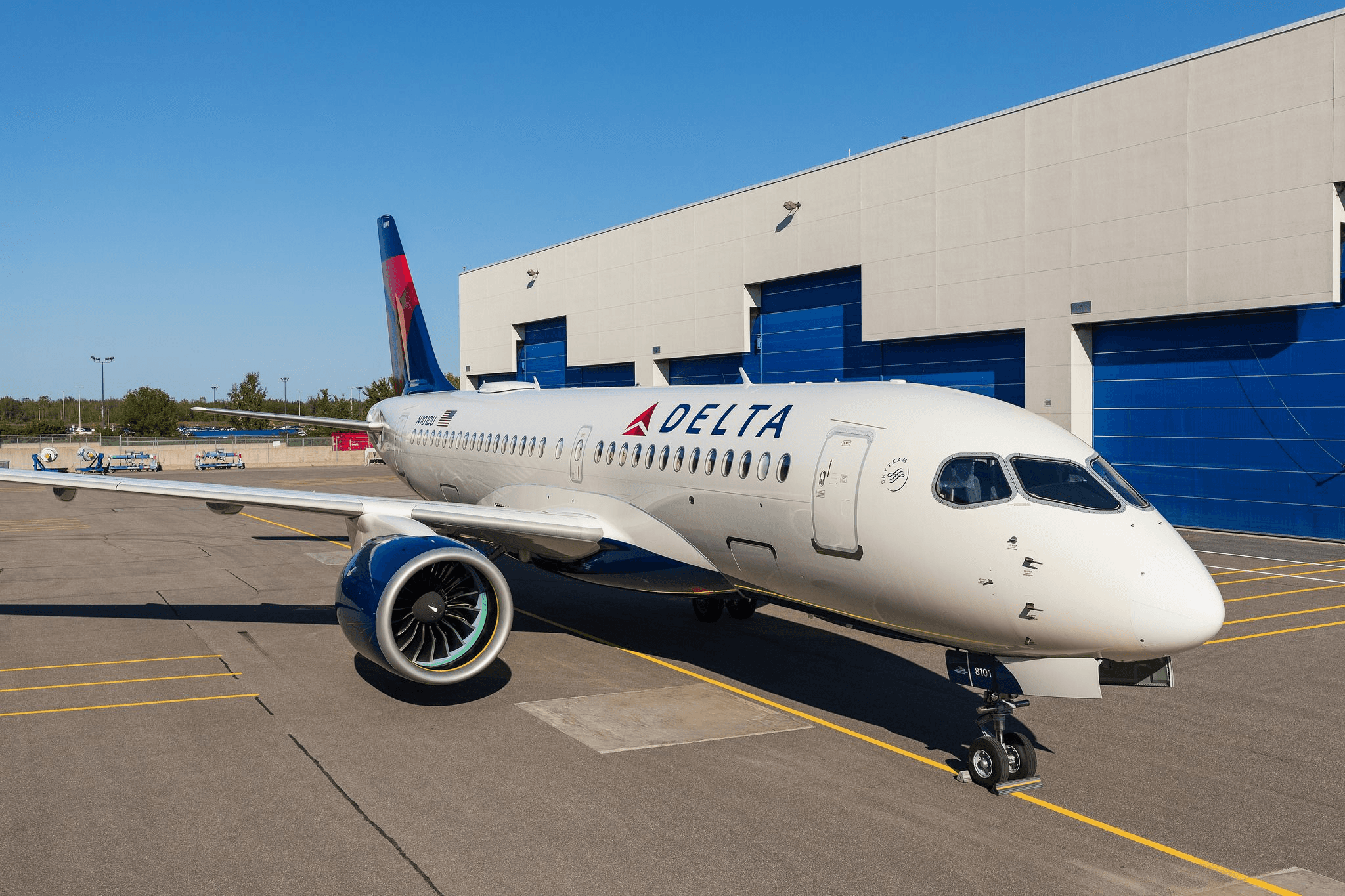
Delta Airbus A220-100 Seat Guide (2026) | Cabin
TL;DR
Delta's A220-100 carries 109 seats in a 2-3 layout - the most important thing to know. Unlike every other narrowbody in the US domestic fleet, the A220 has no middle seat in the window blocks. Every passenger in the 2-seat sections (A and C) has only one neighbour. First Class is a genuine 2-2 product. The aircraft is significantly quieter than legacy regional jets. If you can choose this aircraft over a CRJ or Embraer on a short-haul route, choose this aircraft.
Try Cabin
The A220-100 is the most passenger-friendly regional jet flying in the United States - and Delta has configured it with a First Class cabin and proper IFE that make short-haul routes feel genuinely different from the regional jets it replaced. The seat intelligence here is about a narrow-body that surprises passengers consistently.
Delta Air Lines operates the Airbus A220-100 on short and medium-haul domestic routes from its Atlanta, Minneapolis, and New York hubs, connecting secondary markets that previously received CRJ-200 or CRJ-900 service. The A220-100 is a 109-seat aircraft - smaller than a 737 - but the cabin width is wider than any narrowbody in the US regional fleet, and the 2-3 seating configuration eliminates the double-middle-seat problem that makes regional flying uncomfortable.
The 2-3 layout - the defining advantage
The A220-100's cabin is configured in a 2-3 layout rather than the 3-3 found on narrowbodies or the 2-2 on true regional jets. This creates an asymmetric cabin: the left side has 2-seat rows (A and C positions), and the right side has 3-seat rows (D, E, F). The 2-seat left-side window sections have only one neighbor - a meaningful comfort difference on a 2-3 hour route versus the standard regional jet middle seat experience. Solo travelers should specifically target the A/C left-side seats when possible.
First Class
Delta First Class on the A220-100 is a 2-2 layout with 12 seats across 3 rows. Seat width is 21 inches and pitch is 38 inches. This is a proper First Class product — not the 2-1 cramped configuration of many regional jets — and it is deployed on routes that receive the A220-100 rather than an ERJ or CRJ. The seat reclines to approximately 40 degrees. Row 1 deplanes fastest; Row 3 is furthest from the forward galley and typically the quietest First Class row. The 9-inch IFE screens are a step up from the seatback-free regional jet experience and include Delta's standard domestic entertainment library.
Comfort+
Comfort+ on the A220-100 occupies the first few rows of the Main Cabin - typically rows 4-8 on Delta's standard configuration. Pitch is 34 inches. The left-side Comfort+ seats (A and C) continue the 2-seat no-middle-neighbor advantage from the cabin layout. On the A220-100 specifically, the Comfort+ left window pair is the best non-premium seat available - 34 inches of pitch with only one neighbor in a cabin that is meaningfully wider than a CRJ or Embraer equivalent.
Main Cabin
Main Cabin on the A220-100 uses the standard 2-3 layout at 30-31 inches of pitch. The IFE system is fully functional on the A220-100 - each seat has a seatback screen, unlike the Gogo streaming-to-device setup on some Delta narrowbodies. USB-A charging is standard at each seat. The overhead bins on the A220 are larger than typical for an aircraft of this size, and gate-checking bags is significantly less common than on the CRJ fleet. Left-side window seats (A and C) have one neighbor maximum. Right-side window seat (D) has two neighbors. Right-side aisle seat (F) has no neighbor contact issues but is the standard aisle position.
The noise profile - a genuine differentiator
The A220-100's Pratt & Whitney PW1500G geared turbofan engines are among the quietest turbofans in the regional aircraft segment. Passengers transitioning from CRJ-200 or CRJ-900 service to the A220-100 on the same routes consistently note the noise reduction as the most immediately perceptible improvement. On a 2-hour regional route, a quieter cabin reduces fatigue measurably - particularly relevant for business travelers making multiple short-haul segments in a single day.
Why the A220 beats the regional jet alternatives
The three specific advantages over CRJ and Embraer operations on the same routes are: the 2-3 layout eliminating double-middle seats, the significantly lower cabin noise, and the full seatback IFE rather than bring-your-own-device streaming. For frequent short-haul travellers who regularly fly Delta's secondary markets, seeking out A220-100 service when scheduling permits is a meaningful quality-of-journey improvement.
Best seats
Seat | Cabin | Why |
|---|---|---|
Row 2 A or C | First Class | Mid-cabin First Class. Away from forward galley noise, full recline, quiet position. |
Comfort+ A or C (rows 4-8 left side) | Comfort+ | 34-inch pitch with only one neighbor. The best non-premium seat on the aircraft. |
Main Cabin A or C (forward rows) | Main Cabin | Left-side window pair. One neighbour maximum - the A220's defining Economy advantage. |
Seats to avoid
Seat | Cabin | Why |
|---|---|---|
Last row E (right-side middle) | Main Cabin | Middle seat in the last row with no recline. The worst position on the aircraft. |
Right-side E seats generally | Main Cabin | The middle seat in the 3-seat right-side block. Unavoidable on full flights, but book early to secure left-side seats. |
Why does the Delta A220-100 have a 2-3 layout instead of 3-3?
The A220-100 (formerly Bombardier CSeries) has a narrower fuselage than a 737 or A320. Airbus and Bombardier designed the cabin for maximum passenger comfort rather than maximum density - a 3-3 layout would produce seats too narrow for comfortable flying. The 2-3 layout gives the aircraft its defining passenger advantage.
Is Delta's A220-100 better than the A220-300?
Delta operates the A220-100 (shorter variant) and the A220-300 (longer variant) on different routes. The A220-300 carries more passengers in the same 2-3 layout. For passengers, the seat product is identical - the choice between them is purely route-based.
Does the Delta A220-100 have seatback screens?
Yes. Delta's A220-100 is equipped with seatback IFE screens in all cabins - unlike some Delta narrowbody configurations that use streaming-to-device systems. This is one of the aircraft's practical advantages over older regional jets on the same routes.
What routes does Delta fly the A220-100 on?
Primarily short and medium-haul domestic routes from Atlanta, Minneapolis, and New York hubs to secondary markets previously served by regional jets. The specific routes vary - check the aircraft type during booking to confirm.
delta, a220-100, a220, regional jet, domestic, seat guide