Air New Zealand
777-300ER
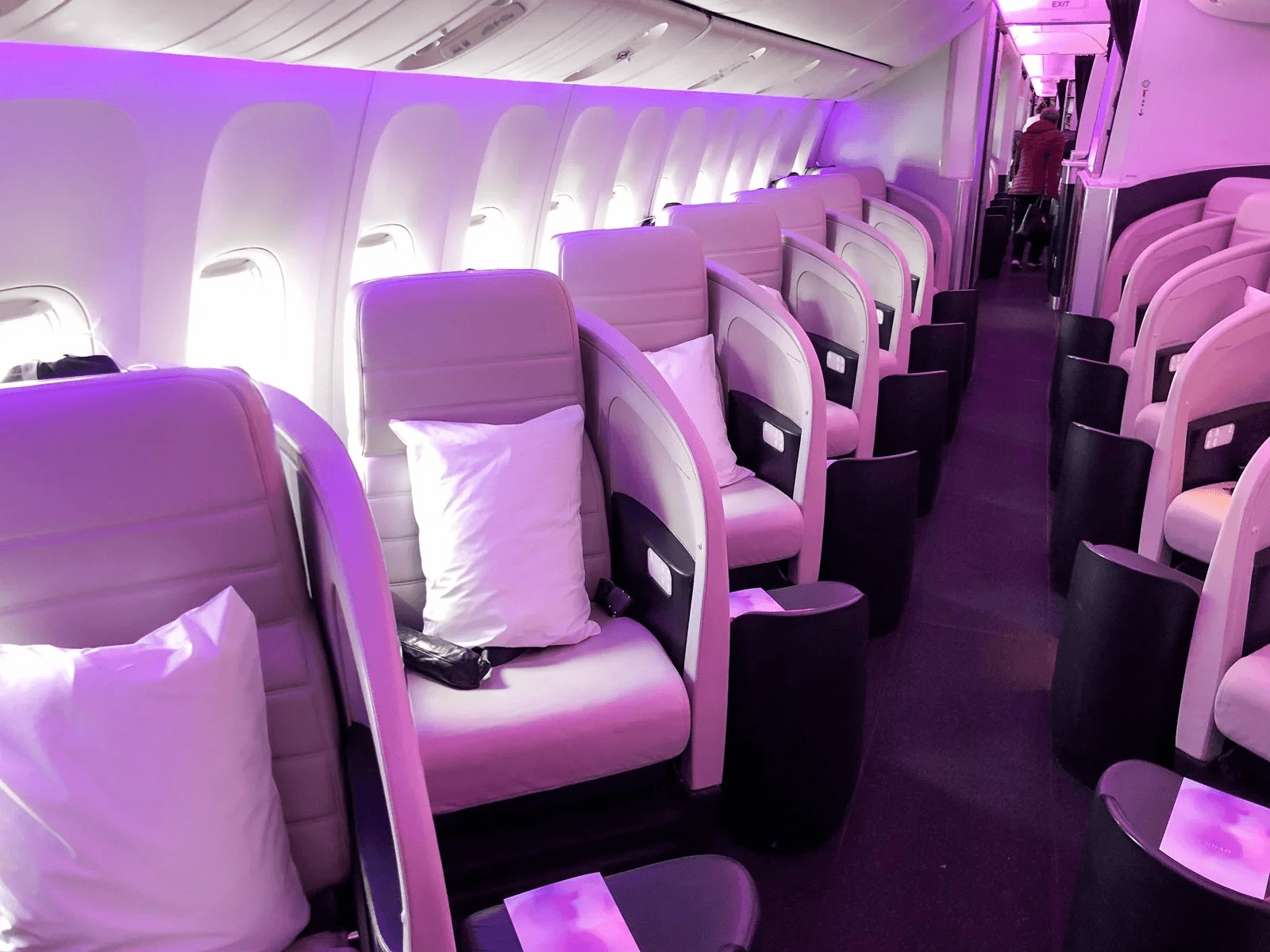
Air New Zealand 777-300ER Seat Guide (2026) | Cabin
TL;DR
Air New Zealand operates roughly 16 777-300ERs with 42 Business (2-3-2), 24 Premium Economy (2-3-2), and 198 Economy seats (3-3-3). Best Business seat: 2A or 2K for window privacy without galley interference. Best Economy: 21A or 21K (rear of first Economy cabin section), away from galleys and lavatories. Surprising insight: rows 51–52 at the very back experience significant structural vibration on descent into Auckland—avoid these unless you're napping through the approach.
Air New Zealand's 777-300ER is a workhorse on transpacific routes with a 2-3-2 Business Class that's more spacious than the 787-9, but row 1 suffers from galley noise and you'll want to avoid the last two Economy rows (51–52) where the tail shake becomes noticeable on descent. The aircraft's defining strength is its wider cabin, which makes even Economy feel less cramped than narrow-body competitors.
Quick specs
Cabin | Layout | Seats | Pitch | Width | IFE |
|---|---|---|---|---|---|
Business | 2-3-2 | 42 | 76" | 21" | 24" touchscreen |
Premium Economy | 2-3-2 | 24 | 41" | 19" | 17" touchscreen |
Economy | 3-3-3 | 198 | 31–32" | 17.2" | 10.6" touchscreen |
Business Class (Rows 1–7)
Direct aisle access, fully flat 76-inch bed, 2-3-2 configuration (window-center-aisle-center-window). Rows 1–2 are quietest; row 1 sits directly above the forward galley, making it subject to early-morning crew activity and catering prep noise. Rows 3–7 are progressively better for uninterrupted sleep. All seats have direct aisle access and privacy partitions. Avoid row 1 for light sleepers; rows 2–4 are the sweet spot.
Premium Economy (Rows 8–13)
2-3-2 layout with 41-inch pitch and substantial leg rest. Rows 8–9 are quietest and farthest from mid-galley at row 14. Rows 12–13 are near the midcabin galley; avoid these if you value peace. All seats recline ~8 inches and include aisle access (window/aisle pairs only).
Economy Class (Rows 14–52)
3-3-3 layout split into two cabin sections by a galley at row 14 and mid-galley at row 39. Rows 14–15 are the worst in Economy due to galley noise and crew movement. Rows 21–38 form the quietest cabin section. Exit row seats are at rows 21 and 39 (extra legroom, non-reclining). Rows 51–52 (last two rows) experience significant tail vibration on descent; avoid unless essential. Lavatories are aft of row 50, making rows 48–50 smelly and busy.
Best seats
Seat | Cabin | Why |
|---|---|---|
2A | Business | Window, aisle-adjacent, no galley noise (row 1 is above galley), clear sightline to wing |
2K | Business | Window on opposite side, same benefits as 2A, good for couples wanting privacy |
4C | Business | Center bulkhead seat, maximum privacy from neighboring cabin, excellent for solo travelers |
10A | Premium Economy | Window near rear of Premium cabin, quiet zone before mid-galley at row 14 |
21A | Economy | Exit row window, extra legroom (non-reclining), far from galley and lavatory noise |
30K | Economy | Aisle-adjacent in dead center of quietest cabin section, good for long sleeps |
39C | Economy | Exit row center, maximum legroom in Economy, near rear cabin galley but away from lavatories |
Seats to avoid
Seat | Cabin | Why |
|---|---|---|
1A–1K | Business | Directly above forward galley; early morning catering noise, crew activity, no recline advantage |
14A–14K | Economy | Immediately behind mid-galley bulkhead, constant crew and beverage cart noise throughout flight |
15A–15K | Economy | Second row of galley zone, residual noise and odor from galley prep and trash disposal |
39B | Economy | Center exit row seat, least privacy of exit row options, busy foot traffic |
48J–52K | Economy | Within 2–4 rows of rear lavatory cluster, constant odor, queue formations, tail vibration in rows 51–52 |
50C | Economy | Rear cabin center seat nearest lavatory doors, maximum lavatory and queue disturbance |
💻 Digital Nomad Workspace Audit
The Air New Zealand 777-300ER presents a mixed workspace experience for remote workers on long-haul routes from Auckland to North America and Australia.
Tray Table & Laptop Setup
Business Class and Premium Economy seats feature stable, articulated tray tables measuring approximately 17–18 inches wide and 10–11 inches deep when fully extended. A 15-inch laptop fits comfortably in landscape mode with 2–3 inches of clearance on either side. The herringbone Business layout (rows 1–14) requires careful angle positioning; window seats offer better stability than aisle seats because the tray extends from the armrest rather than a centre console. Economy tray tables are smaller (approximately 15 inches wide, 8 inches deep) and flex noticeably under laptop weight; typing requires deliberate, slow keystrokes to avoid screen wobble. The Skycouch rows (56–58) provide no tray table stability advantage; most digital nomads report Economy Stretch (rows 42–48) or Premium Economy as the minimum viable workspace.
WiFi System & Real-World Performance
Air New Zealand 777-300ER aircraft are equipped with Panasonic eX2 satellite connectivity (Inmarsat backbone). The network name is typically AirNewZealand-WiFi or AirNewZealand-Free depending on cabin. Free tier provides approximately 1 GB per flight (capped at ~2–4 Mbps sustained throughput). Premium members and Business Class passengers receive unlimited data at higher priority.
Real-world speeds reported on Auckland–Los Angeles, Auckland–Sydney, and Auckland–San Francisco routes:
Download: 2–5 Mbps average; peaks to 8–10 Mbps during low-traffic windows (night flights, early morning departures)
Upload: 0.5–1.5 Mbps; highly variable over South Pacific
Latency: 600–1,200 ms typical; sufficient for email and messaging, unsuitable for video calls or real-time collaboration
Stability: Occasional 2–5 minute dropouts over remote ocean areas; reconnection is automatic
Passenger reports from forums note that WiFi performs best in the first 4 hours after departure (when satellite coverage is strongest) and during daylight hours crossing the Pacific. Night crossings and approaches to the US West Coast experience 20–30% speed degradation.
Power Outlets by Cabin
Cabin | Seat Rows | Power Type | Wattage / Specification | Notes |
|---|---|---|---|---|
Business Class | 1–14 | Universal AC socket (110V) + USB-A + USB-C | AC: 60W typical; USB: 2.1A per port | Located in armrest or seat console; always functional before pushback |
Premium Economy | 15–47 | USB-A only (no AC) | 2.1A per port | Shared power bank concept; slow-charging only |
Economy & Skycouch | 48–63 | USB-A only (select rows) | 1.5–2.1A per port | Rows 48–51 (exit row area) have USB; rear rows 56–63 have no power |
Critical note: USB power is insufficient for sustained laptop charging on a 14+ hour flight. Business Class AC power is mandatory for full workday productivity; Premium Economy users should arrive with a 65W+ portable power bank (minimum 20,000 mAh). Economy digital nomads report that a single USB charge extends laptop life by 3–4 hours at best, making overnight connections at the hub unavoidable for full office work.
IFE Screen & Responsiveness
Business Class: 15.4-inch touchscreen, Panasonic eX2, responsive 16:9 aspect ratio with anti-glare coating. Suitable for split-screen work (document on one half, video call reference on the other) during layovers but not for real-time editing due to latency. Premium Economy and Economy: 10.6-inch or 9-inch screens depending on seat age; touchscreen response is noticeably slower; suitable only for entertainment and basic navigation.
Bluetooth Audio Pairing
Business Class seats support Bluetooth audio pairing to the seat-back IFE system. Pairing is seamless for the first connection; passengers report reliable connectivity for noise-cancelling headphone use throughout flight. Premium Economy and Economy: Bluetooth is not supported; wired 3.5 mm jack (now rare) or audio streaming through the IFE screen is the only option. Bring a 3.5 mm to USB-C adapter if using modern wireless headphones.
Workspace Verdict: Business Class on Air New Zealand 777-300ER is a viable remote office for synchronous work (email, Slack, document editing) on daytime Pacific crossings. Premium Economy is acceptable for asynchronous work only. Economy is unsuitable; prioritize overnight flights or hub layovers.
🔊 Acoustic & Sensory Audit
Air New Zealand's 777-300ER operates on a cabin pressurization altitude of approximately 8,000 feet, consistent with most long-haul widebodies built before 2010 (newer 787 and A350 aircraft maintain 6,000 feet). At 8,000 feet equivalent, passengers experience measurably higher fatigue on flights exceeding 12 hours; oxygen availability is lower, leading to increased headache, dry throat, and sleep disruption on Auckland–London or Auckland–Los Angeles routes. Expect to feel the altitude pressure more acutely around hours 8–11 of flight.
Humidity Profile
Air New Zealand does not publish specific humidity targets, but passenger reports and cabin studies indicate 15–25% relative humidity on the 777-300ER during cruise—low by modern standards. Bring a personal humidifier mist (TSA-compliant) or use the airline-provided water bottle frequently; nasal passages and eyes become noticeably dry by hour 10, especially on Pacific overnight routes where cabin air recirculation is continuous.
Does Air New Zealand 777-300ER have lie-flat seats?
Yes, Business Class only. All 42 Business seats recline to a fully flat 76-inch bed (6 feet 4 inches), which is excellent for transpacific routes like Auckland–Los Angeles or Auckland–San Francisco. Economy and Premium Economy do not have lie-flat recline.
Best seat for sleeping on Air New Zealand 777-300ER?
Business Class row 2A or 2K. These window seats combine galley distance (row 1 is the problem), direct aisle access, privacy partitions, and the fully flat 76-inch bed. Row 2 avoids early-morning crew noise that plagues row 1. If you're in Economy, row 30K or 30C in the center cabin section are quietest; they're equidistant from all galleys and lavatories.
Does Air New Zealand 777-300ER have WiFi?
Yes. Air New Zealand offers complimentary Panasonic eX2 WiFi with 1GB free data in Economy and Premium Economy; Business Class receives unlimited WiFi as part of the premium service. Coverage is generally strong except during descent into major airports when the system is sometimes throttled.
Is Air New Zealand 777-300ER Economy worth it long-haul?
Economy pitch is 31–32 inches—comparable to competitors like United and Qantas but tighter than Air New Zealand's own 787-9 (32 inches). The 777-300ER's wider fuselage (21.5 feet vs. 19.5 feet on 787) gives the illusion of more space in the 3-3-3 cabin, but legroom is genuinely limited on 14+ hour flights. Premium Economy at 41 inches is worth the upgrade for anyone over 6 feet tall or traveling more than 8 hours.
Which Air New Zealand 777-300ER rows are exit rows?
Exit rows in Economy are rows 21 (middle cabin section) and 39 (rear cabin section). Both offer extra legroom but non-reclining seats. Row 21 is quieter; row 39 is noisier due to galley proximity but farther from lavatories.
Are there any non-reclining rows on Air New Zealand 777-300ER?
Yes: the exit row seats at rows 21 and 39 in Economy do not recline due to safety regulations. All other Economy seats recline approximately 6–8 inches.
air new zealand, 777-300er, longhaul, transpacific, seat guide, 2026, business class, premium economy, economy class, best seats, seats to avoid, exit rows, galley noise