Air Canada
737-MAX-8
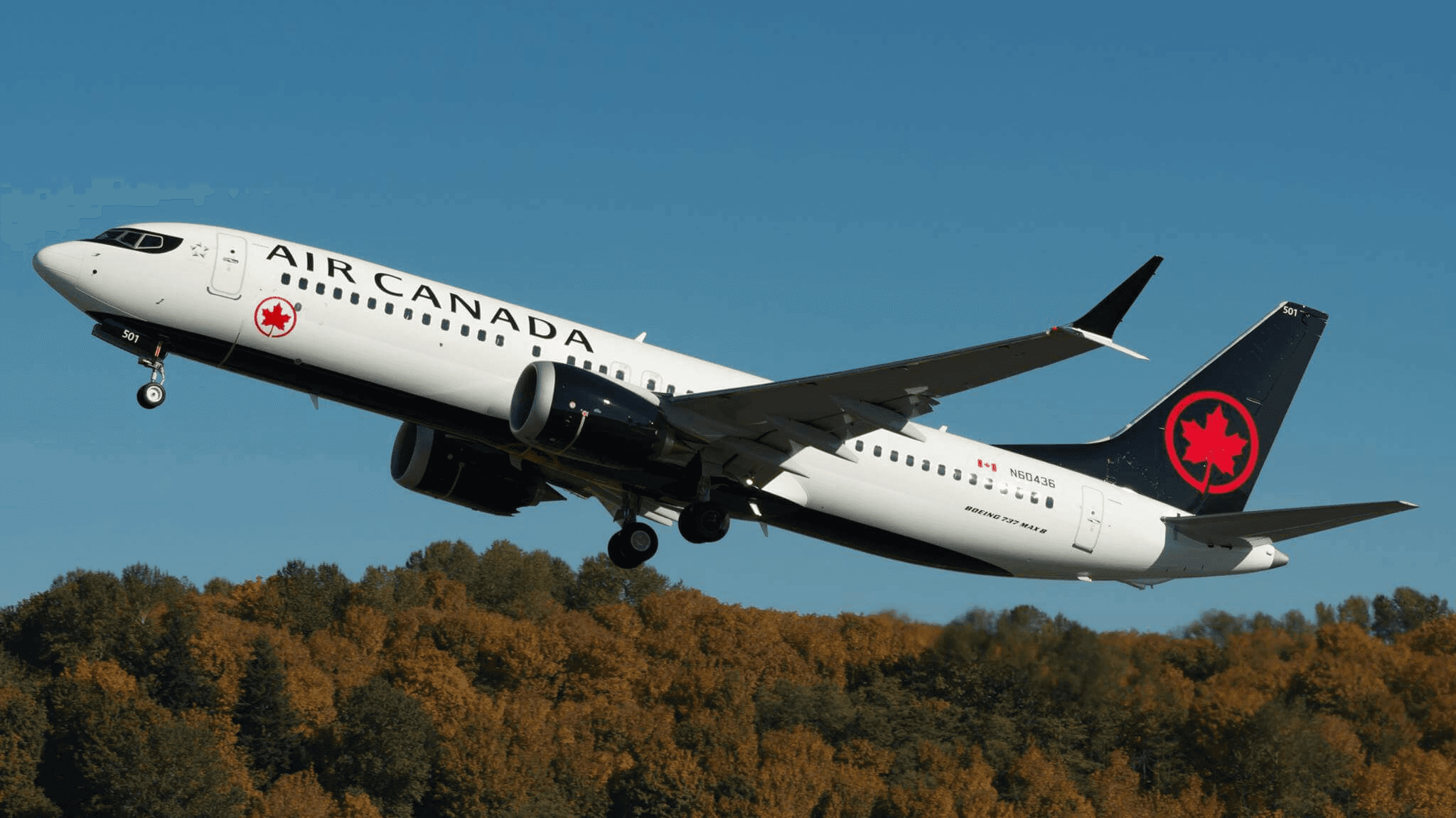
Air Canada 737-MAX-8 Seat Guide (2026) | Cabin.coach
TL;DR
Air Canada's 737-MAX-8 carries 20 Business Class lie-flat seats (rows 1–4, 1-2-1 staggered layout) and 177 Economy seats in a 3-3 layout (rows 5–35). Business Class offers direct-aisle access on odd rows and superior privacy; avoid row 4 due to galley proximity. In Economy, exit row seats 17A–18F and 28A–28F deliver 35" pitch, but skip row 11 entirely if you want a window. The MAX's quieter engines and higher cabin pressure mean you'll arrive less fatigued than on legacy 737-800 equipment, especially valuable on routes over 5 hours.
Air Canada's 737-MAX-8 squeezes 197 seats into a narrow-body, with 20 lie-flat Business Class pods up front and a dense 177-seat Economy below. The MAX's LEAP-1B engines run significantly quieter than older 737s, but row 11 has no windows—a quirk that catches many passengers off guard. The real win here is the Boeing Sky Interior's oversized overhead bins and superior cabin pressure, which means less fatigue on 4–5 hour transatlantic hops.
Quick specs
Cabin | Layout | Seats | Pitch | Width | IFE |
|---|---|---|---|---|---|
Business | 1-2-1 (staggered) | 20 | 6'8" | 21" | 11.6" HD touchscreen + control panel |
Economy | 3-3 | 177 | 28–35" | 17.2" | 9" standard + larger screens on newer aircraft |
Business Class
Air Canada's 737-MAX-8 Business Class occupies rows 1–4 in a 1-2-1 configuration with full lie-flat beds (6'8" length). Odd rows (1, 3) have direct aisle access and superior privacy; even rows (2, 4) share a middle divider with slight sightline compromise. Rows 1 and 3 are optimal for solo travelers and couples seeking maximum seclusion. Row 4 sits directly above the Economy galley (rows 5–6), creating minor noise and service activity—skip this row if possible. All Business seats feature on-demand entertainment, direct aisle access on alternating rows, and AC power.
Economy Class
Economy spans rows 5–35 in a standard 3-3 layout with 28" pitch in the main cabin (rows 5–16) and 28" in the rear (rows 17–35). Exit row seats at rows 17–18 and row 28 offer 35" pitch and are the best Economy seats on the aircraft. Row 15 (directly ahead of the overwing exit at row 17) does not recline—avoid if you plan to sleep. Row 11 has no windows across the entire row—a common MAX quirk that frustrates window seat bookers. Rows 32–35 are the loudest and closest to the rear lavatories; avoid if you're sensitive to galley and lavatory traffic. The rear lavatories are notoriously tight, with barely enough room to turn around.
Premium Economy
Air Canada does not offer Premium Economy on the 737-MAX-8. Economy Plus is available at select exits (rows 17–18, row 28) with 35" pitch and priority boarding.
Best seats
Seat | Cabin | Why |
|---|---|---|
1A or 1F | Business | Direct aisle access, full lie-flat bed, bulkhead privacy, quietest forward cabin location on transatlantic routes |
3A or 3F | Business | Optimal middle ground—full privacy, direct aisle, away from galley noise at row 5 |
17A or 17F | Economy Plus | Exit row with 35" pitch, quickest deplaning, no one in front, window or aisle choice |
18C or 18D | Economy Plus | 35" pitch middle seats with window views (if row 18 has windows) and superior legroom without the aisle traffic of A/F |
28A or 28F | Economy Plus | Second exit row pair with 35" pitch, quieter location than rows 17–18, excellent for solo travelers or window preference |
Seats to avoid
Seat | Cabin | Why |
|---|---|---|
4A or 4F | Business | Directly above Economy galley activity; noise and service cart movement during meal prep |
11A, 11B, 11C, 11D, 11E, 11F | Economy | Entire row lacks windows due to fuselage cutout—avoid if window view is a priority |
15A–15F | Economy | Fixed non-recline seats directly ahead of the overwing exit; no recline means no sleep comfort |
32–35 (all seats) | Economy | Loudest rear section, closest to cramped rear lavatories, galley and lavatory queues create constant foot traffic |
21A or 21F | Economy Plus | Exit row door structure can make armrest less comfortable and restrict legroom extension on the armrest side |
💺 Premium Economy Section
Air Canada's 737-MAX-8 Premium Economy cabin occupies rows 8–15 and seats 16 passengers across a 2–2 configuration (A–B window pair, C–D aisle pair per row). Pitch is 32 inches—a meaningful 4-inch gain over Economy's standard 28 inches—but falls short of the 38-inch pitch found on Air Canada's wider-body Premium Economy products. Seats are Zodiac Z4100 slimline recliners with 6.5 inches of recline, which on a 4–5 hour domestic route provides modest comfort but won't rival lie-flat business class.
The Premium Economy galley sits forward of row 8, meaning cabin crew service begins immediately after departure. Meal service in Premium Economy is hot plated and à la carte-quality—not dramatically different from Economy's offering on short-haul routes, but quantities are more generous and you receive a pre-departure beverage and amenity kit (socks, toothbrush, eye mask) as standard. On routes under 5 hours, the amenity kit and extra legroom justify the upgrade for solo travellers; couples should book A–B or C–D to secure a pair.
Lounge access: Premium Economy passengers on Air Canada's 737-MAX-8 do not receive dedicated lounge access—you're eligible only if you hold Star Alliance Gold status or above, or if you've purchased a premium fare. This is a significant disadvantage versus competitors like United, which grants basic lounge access to Premium Economy ticket holders system-wide.
Best rows in Premium Economy:
Row 8A/B (window pair): Shortest walk from front galley; avoids being directly above the wing. Armrests are fixed and do not retract, which makes the seat feel slightly narrower than it is.
Row 12C/D (aisle pair): Sweet spot for solo travellers—galley proximity is less relevant, and you avoid the front bulkhead rigidity. Armrest is padded and retracts fully.
Avoid rows 14–15: These sit directly ahead of the over-wing exit rows; airflow and crew movement from the exit corridor create noise and draught. Row 15 seats do not recline.
✈️ Version Lottery
Air Canada operates a single standardised 737-MAX-8 cabin configuration across its domestic and regional narrow-body network. All aircraft in the carrier's MAX fleet feature the Boeing Sky Interior (larger overhead bins, LED mood lighting, higher cabin pressure), Zodiac Z4100 slimline seats throughout, and identical galley and lavatory placement. There are no privacy doors between cabin classes (unlike some competitors' retrofitted MAX aircraft), and no regional variants—a domestic Toronto–Vancouver flight operates the exact same product as a transborder Toronto–New York service.
Air Canada's website seat map and SeatGuru both display the full 197-seat configuration for every MAX-8. There is no version lottery to play—you're receiving the same aircraft experience whether you book flight AC105 or AC204. The only meaningful variable is which specific aircraft (tail number) operates your flight; Air Canada's newest MAX aircraft (delivered 2022–2024) may have slightly fresher interiors, but seat comfort and pitch are identical. Changing your flight date or time to secure a different aircraft tail is not worth the effort on this fleet, as the configuration difference is negligible. Focus instead on seat selection (exit rows, Premium Economy positioning) rather than aircraft swapping.
🏆 Competitive Verdict
Air Canada's 737-MAX-8 is outmatched by United Airlines' comparable 737-MAX-8 on the same Toronto–New York and Vancouver–San Francisco routes. United's MAX aircraft feature full seatback entertainment screens in Economy (Air Canada: none), more aggressive Premium Economy pricing (making upgrades more accessible), and—critically—United grants lounge access to Premium Economy ticket holders, while Air Canada does not. For solo overnight travellers on 4–6 hour routes, United's seatback IFE wins decisively; couples wanting to sit together will find identical pitch and space on both carriers, but United's dynamic pricing often makes their Premium Economy cheaper. Tall passengers over 6 feet should book exit rows on either carrier—both offer 35-inch pitch in rows 17–18—but United's overhead bin depth is marginally superior due to newer-generation Sky Interior retrofits. Work-focused business travellers should avoid both carriers' MAX-8 for anything requiring productivity: neither offers lie-flat seats, WiFi, or USB power. For this segment, Air Canada's 787 or United's 767-400ER is the honest choice. Verdict: United wins 3–1 on the MAX-8, particularly for Premium Economy access and Entertainment.
🛁 Lounge & Ground Experience
Air Canada's primary hub for 737-MAX-8 operations is Toronto Pearson (YYZ). Premium passengers and Star Alliance Gold members access the Air Canada Maple Leaf Lounge (Terminal 1, Concourse A), which spans 14,000 square feet and features four shower suites (modest single showers, not spa-grade), à la carte dining by Executive Chef (hot proteins, seasonal salads, artisanal cheese), self-service bar with premium spirits, and a dedicated Business Centre with workstations and meeting rooms. The lounge does not offer day beds, spa services, or dedicated rest areas—amenities stop at shower access and seating.
Access tiers: Air Canada Maple Leaf Lounge access is granted to Tier 3+ Aeroplan status (Elite/Super Elite), business class ticket holders, and select premium fare classes. Premium Economy passengers receive no lounge access unless they hold Gold status independently. This is a critical gap: routing via Toronto Pearson on a Premium Economy ticket does not improve your ground experience versus a competitor hub (e.g., Newark on United, where Premium Economy grants lounge access). If you're connecting internationally through Toronto and lack premium status, you're confined to the terminal food court and retail.
Honest assessment: Do not add routing time via Toronto Pearson specifically for lounge access unless you already qualify via status. Air Canada's Maple Leaf Lounge is respectable for showers and à la carte dining but ranks below United's Club at Newark and Delta's Sky Club at Atlanta in consistency and ambience. If your journey is a simple domestic or transborder hop (e.g., Toronto–Boston), the ground experience is immaterial; if you're connecting internationally and lack lounge access, a direct flight on an alternative carrier (even with a slight schedule compromise) is worth evaluating to avoid a frustrating 2-hour layover in the main terminal.
🌙 Overnight Formula
Book seat 21B or 21E (exit row, aisle side of the center pair) on any Air Canada 737-MAX-8 overnight route. The 35-inch pitch gives you enough space to cross your legs or tuck a pillow behind your back; the aisle seat offers unobstructed access to the lavatory without disturbing a seatmate. Avoid the window exit row seats (21A, 21F) unless flying solo—the door structure and armrest angles make side-sleeping awkward, and the galley noise from the forward cabin is louder than from a mid-cabin aisle seat.
Does Air Canada 737-MAX-8 have lie-flat seats?
Yes. Business Class (rows 1–4) features full lie-flat beds with 6'8" length, 21" width, and direct aisle access on odd rows (1, 3). Lie-flat beds are exclusive to Business Class; Economy has no recline anywhere on the aircraft.
Best seat for sleeping on Air Canada 737-MAX-8?
1A or 1F in Business Class—bulkhead location means no foot traffic above, full lie-flat position, and quietest cabin environment. On transatlantic routes (YYZ–LHR, YYZ–CDG), sleep quality is significantly better than legacy 737-800 due to the MAX's superior cabin pressure and LEAP-1B engine noise reduction.
Does Air Canada 737-MAX-8 have WiFi?
Yes. Air Canada offers Intelsat-powered WiFi (branded as Viasat on some MAX aircraft) with pass-per-flight or monthly subscription options. Coverage is continuous across North America and the Atlantic; speeds are moderate (3–5 Mbps) but reliable for messaging and basic browsing. Business Class includes complimentary WiFi; Economy WiFi is paid unless you hold elite frequent flyer status.
Is Air Canada 737-MAX-8 Economy worth it long-haul?
Economy on the 737-MAX-8 is tight but not painful for flights under 5 hours. The 28" pitch matches budget carriers, but the MAX's higher cabin pressure (1,600 ft equivalent vs 8,000 ft on older 737s) and 20% humidity improvement significantly reduce fatigue on 4–5 hour routes to Europe. For 6+ hour flights, Business Class or a competitor's wider-body (A350, 787) is a better value. On shorter transatlantic routes (YYZ–Dublin, YYZ–Shannon), Economy Plus exit rows (35" pitch) are worth the upgrade.
Which rows have overhead bin restrictions?
Bulkhead row 1 and exit-row seats 17, 18, and 28 may have stricter carry-on rules for safety and evacuation compliance. Always stow bags fully at these rows; the flight attendant will direct you. The Boeing Sky Interior overhead bins are larger than most 737-800s, so standard roller bags fit easily in most rows.
Are there any windowless rows besides row 11?
Row 11 is the primary windowless row. Rows 14 (especially 14A and 14F) may have misaligned or obstructed windows due to the fuselage structure, though some seats still have partial views. If a window view is essential, book rows 6–10, 12–13, 15–16, 19–31, or 33–35.
How quiet is the 737-MAX-8 compared to older 737s?
Noticeably quieter. The LEAP-1B engines produce roughly 4–5 dB less cabin noise than the CFM56-7B engines on 737-800s, particularly in the rear cabin (rows 20+). On a 4-hour flight, the noise reduction is genuinely noticeable and contributes to lower fatigue, especially in Economy where acoustic comfort matters most.
Can I recline in Economy?
No. All 177 Economy seats on Air Canada's 737-MAX-8 are fixed in a pre-reclined position—none recline. Row 15 seats are locked upright as well. This is a trade-off for the MAX's higher density (197 total seats) and superior cabin pressure.
air canada, 737-max-8, seat guide, 2026, business class, economy class, lie-flat beds, exit rows, best seats, seats to avoid, transatlantic